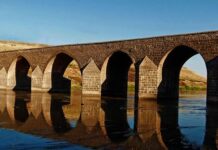
Anyone who looks upon this great wooden bridge cannot help but feel amazed. The bridge is built entirely of wood and includes strong wooden towers, firm railings, solid flooring, and countless supporting beams beneath it. When one considers its enormous size and careful construction, it is natural to wonder how such a vast supply of timber could ever have been gathered, and how the structure could be repaired and maintained year after year. The forests that must have fed this work seem almost endless Sightseeing Ephesus.
I speak of this matter more fully elsewhere, but it must be said here that this bridge forms the most important passage into Hungary from Servia and the Turkish dominions. It is a key route for armies, merchants, and travelers. If this bridge had been properly defended in earlier times, especially when Sultan Suleiman invaded Hungary, it is very likely that he would not have advanced so easily toward Buda. Control of this crossing could have changed the course of history.
War and the Destruction of the Bridge
During later conflicts, efforts were made to block the enemy’s supply lines. To prevent the army of the Grand Vizier from receiving provisions and reinforcements from other parts of Turkey, Count Nikola Zrinski (Serini) ordered the destruction of the section of the bridge that crossed the Drava River. This bold act greatly disrupted Ottoman movement in the region.
On his return from this campaign, Count Serini also burned Quinque Ecclesiae, known as the City of Five Churches and today called Pécs. This city lies to the southwest of Eszék (Osijek) and was an important settlement both strategically and religiously. These actions show how warfare in this region often involved not only battles but also the destruction of roads, bridges, and cities to weaken the enemy.
Valpovo and the River Rich in Fish
From Eszék, we traveled onward to Valpovo, where we found a fine wooden bridge crossing the Walpo (Valpovo) River, also called the Vuka by some. This river is rich in fish, providing an important source of food for the local people. To the west of the bridge stands the town of Valpovo, which was captured by the Turks in the year 1645 Journey Through Hungary and the Ottoman Lands.
The town’s position near the river made it valuable both for defense and for trade. Rivers in this region were not only natural borders but also highways for commerce and communication.
Markets, Lakes, and Strong Towns
Continuing our journey, we passed through Sotzin, Vukovar, Šabac, and Ilok, eventually reaching Mitrovica, a large and important town. Mitrovica is well known for its great fairs and markets, which attract traders from many regions. The town is further strengthened by a nearby lake, which adds to its natural defenses.
From there, we traveled on to Šimanovci, keeping a good distance to our right from the famous ancient city of Sirmium. Once a great Roman city and an imperial center, Sirmium is now reduced to a small and insignificant place. I have written about its former glory elsewhere, but here it serves as a reminder of how cities rise and fall over time.
The Regions of Srem and Bosut
The land through which we passed is called Srem (Syrmia), a fertile and historically important region between the rivers Danube and Sava. The area closer to the Drava River is known as Bosut. These regions are marked by rich soil, rivers, and strategic routes, which have long made them valuable and often contested lands.